
 Grade: CG-173
Tri(isopropoxy)vinylsilane
CG-173 (Tri(isopropoxy)vinylsilane) is a silane coupling agent containing both vinyl and isopropoxy functional groups, used for coupling inorganic materials (glass fiber, aluminum hydroxide, magnesium hydroxide, etc.) with organic polymers (EPDM, POE, LDPE, EVA, etc.). Compared to vinyltrimethoxysilane, it features a higher boiling point and flash point, providing safer use.
- CAS No.: 18023-33-1
- EC No.: 241-931-4
- Molecular Formula: C11H24O3Si
- Structural Formula
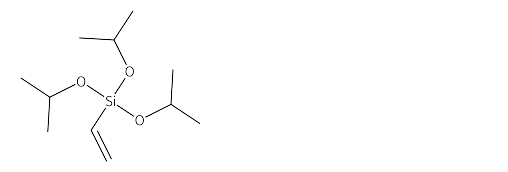
- Appearance: colorless, transparent liquid
- Purity: ≥98%
- Density (20 °C): 0.860-0.880 g/cm3
Packaging and Storage
This product can be packaged in 25 kg plastic drums, 200 kg plastic drums, or steel drums. Other package sizes are available upon request. Store in a cool, well-ventilated, dry place in tightly sealed containers, protected from light. Keep away from moisture and sources of ignition. Ensure the lid is tightly sealed and effectively isolates the product from air; moisture in the air can react quickly, thereby leading to hydrolysis and polymerization. Shelf life in the original unopened packaging is one year. This product is irritating to skin and eyes. If it contacts skin, wash with soap. If it contacts eyes, rinse immediately with plenty of water.
Application
CG-173 functions as a silane coupling agent for inorganic materials (glass fiber, aluminum hydroxide, magnesium hydroxide, etc.) and organic polymers (EPDM, POE, LDPE, EVA, etc.), featuring a higher boiling point and flash point compared to vinyltrimethoxysilane for safer use.
CG-173 is applied in low-smoke halogen-free flame retardant cable compound systems or flame retardant plastic systems, improving the dispersibility of fillers in polymers and increasing filler loading. The product can be used directly for filler surface treatment or in-situ treatment in flame retardant cable compound or plastic systems; a recommended dosage of 0.1-3% (based on filler) is suggested, with the optimal amount to be determined through preliminary testing.